
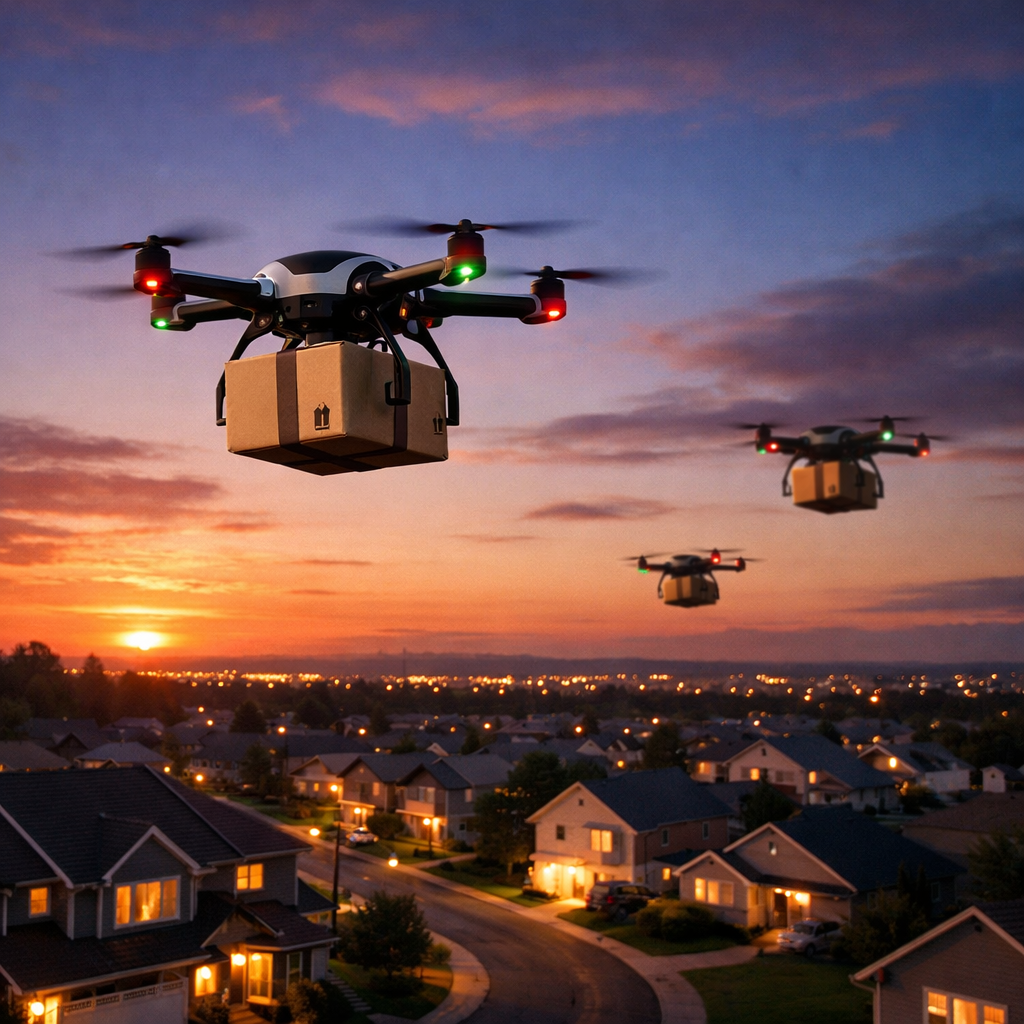
There’s a version of the drone delivery debate that sounds almost boring. Safety. Efficiency. Innovation. Convenience.
And then there’s the version we actually had in the Drone Law Lab. It’s about property. Power. And whether the federal government is quietly on the verge of authorizing one of the largest redistributions of property rights in modern U.S. history.
Thanks for reading! Subscribe for free to receive new posts and support my work.
Everyone agrees on one thing: the FAA isn’t and should not be the referee. The prompt was straightforward: should property rights and compensation be handled through FAA Part 135 certification? The answer, almost across the board, was no. Not because the issue doesn’t matter. Because it matters too much. “The certification process is a safety regime. It was never designed to resolve property disputes.” “If you turn Part 135 into a courtroom, you break the system.”
That line held. The FAA can determine whether an operator can fly safely. It cannot determine whether flying 150 feet over your backyard is a trespass, a nuisance or a constitutional taking. And trying to force it to do so would push the agency well beyond its statutory lane.
So if not the FAA… then who?
Nearly every thread circled back to the same precedent: United States v. Causby. The case is doing a remarkable amount of heavy lifting for a lawsuit about military aircraft and a chicken farm. “Causby gives us ‘immediate reaches,’ but doesn’t tell us where they end.” “We’re applying a World War II framework to autonomous delivery networks.” That’s the problem in a sentence.
We know landowners have rights to the airspace they can use and enjoy. We know repeated, low-altitude overflight can constitute a taking. But we don’t know where the boundary is. 100 feet? 200? 400? And that uncertainty is not academic. It sits directly in the altitude band where drone delivery has to operate.
Out of the discussion, three distinct models emerged. None clean. All consequential.
1. State Control: Local Values, Local Chaos
Some argued this should stay where property law has always lived: with the states. Let Idaho be Idaho. Let Mississippi be Mississippi. “Different communities will have very different tolerances for drone traffic.” “People don’t want drones flying over their porch every thirty minutes.” There’s truth there. Drone delivery is inherently local.
But so is the risk. “A drone could be legal in one jurisdiction and a trespasser in the next.” That’s not just messy. It’s operationally unworkable at scale.
2. Federal Solution: Clarity… and Constitutional Risk
Others pushed for congressional action. Define low-altitude navigational rights. Establish drone corridors. Pair access with compensation, potentially funded by per-flight fees. “The property question is real and can’t be deferred forever.” “Operators need legal certainty if this is going to scale.”
This is the cleanest model on paper. It is also the one that walks straight into the Fifth Amendment. Because once the government authorizes routine access to low-altitude airspace, it must answer whether it is regulating or taking property.
3. The Hybrid: Because We Don’t Have a Choice
The most sophisticated proposals didn’t pick a side. They split the system.
The FAA handles safety. Congress establishes baseline authority. States manage localized impacts and compensation. “Think highways in the sky, with tolls on the way down.”
It’s not elegant. But it might be the only way this works.
Then came the moment where theory met reality. “If you charge ten cents per property, a delivery could cost more in overflight fees than the item itself.” That’s not a throwaway line. It’s the economic reality check. Drone delivery only works if it’s cheap, fast, and scalable. But the very act of scaling increases the number of property interactions, which increases the legal exposure, which increases cost.
At some point, the model collapses under its own legal friction.
Strip away the doctrine, and something more visceral is sitting just below the surface. “People don’t want to give up control of the space above their homes.” “This starts to feel like a forced easement.” “We’re talking about constant, low-altitude traffic over private life.”
This isn’t just about compensation. It’s about control. Privacy. The right to exclude. Things that American property law has historically treated as foundational. And now we are asking whether those rights yield to logistics.
At some point, this becomes unavoidable:
If the federal government authorizes routine, low-altitude drone delivery at scale, is it regulating airspace—or taking property? “You can’t build a national network on top of undefined property rights.” “Eventually, a court is going to have to draw the line.”
And when that happens, it won’t be theoretical. It will determine whether drone delivery becomes infrastructure or litigation.
The Drone Law Lab did not land on answer. But did find a pressure point. The law is holding—for now—because drone delivery is still limited, still experimental, still contained. But everyone in the room saw the same thing coming. “Right now this is manageable. At scale, it won’t be.” And when that shift happens, the question will no longer be whether we need a legal framework.
It will be whether we waited too long to build one.
Steve E. Bartz, Jared Blackburn, Brian S. Brewer, Julian Butler, Sunshine H. Eversull, Roxanne Javor, Christian C. Kobres, Mark M. Majors, Kerry A. Mawn
Leave a Reply